Eastern Gorillas
The lush tropical forests of the Democratic Republic of Congo provide an important home for the eastern gorillas, a group that includes the Eastern Lowland Gorilla, commonly known as Grauer’s Gorilla, and the Mountain Gorilla. However, when people use the term “Eastern Gorillas” in wildlife tourism, they are often referring specifically to Grauer’s gorillas, which are also known as Eastern Lowland Gorillas.
Grauer’s gorillas are scientifically known as Gorilla beringei graueri. They are found only in the eastern part of the Democratic Republic of Congo and are the largest of the four recognized gorilla subspecies. Their natural habitat includes lowland and montane forests, particularly in landscapes around Kahuzi-Biega National Park and other forests of eastern DRC.
These remarkable great apes are critically endangered and face serious threats from habitat destruction, hunting, mining, insecurity and disease. Their conservation is therefore a major priority for wildlife authorities and conservation organizations working in the region. Grauer’s gorillas are fascinating animals because of their enormous size, complex family relationships, intelligence and close resemblance to humans. They are primarily herbivorous and spend much of their time feeding on leaves, stems, shoots, fruits and other vegetation.
Although they are extremely powerful animals, gorillas are generally peaceful when left undisturbed. Within their groups, they spend much of their time feeding, resting, playing, grooming and caring for young ones.
Interesting Facts About Eastern Gorillas
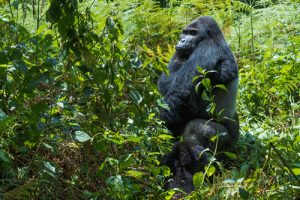
They Are Found Mainly in Eastern Democratic Republic of Congo
Grauer’s gorillas are found only in the Democratic Republic of Congo, making them one of the country’s most important wildlife species. Their range historically covered a much larger area of eastern DRC, but habitat loss, hunting and prolonged insecurity have caused significant declines and fragmentation.
Kahuzi-Biega National Park is one of the most important protected areas for Grauer’s gorillas. The park contains both lowland and highland forest habitats and takes its name from two prominent mountains, Mount Kahuzi and Mount Biega.
Grauer’s gorillas also occur in other forest landscapes, including parts of Maiko National Park, the Tayna landscape and the Mount Tshiaberimu area of Virunga National Park.
Unlike mountain gorillas, which occur in both Uganda and Rwanda as well as the Democratic Republic of Congo, Grauer’s gorillas are endemic to the DRC.
They Are the Largest of the Four Gorilla Subspecies
Grauer’s gorillas are the largest of the four recognized gorilla subspecies. Adult males are considerably larger and heavier than females and can weigh well over 150 kilograms, with exceptionally large males reaching around 200 kilograms or more. Their enormous size is one of the easiest characteristics to notice. They have broad chests, powerful shoulders, long arms and strong legs.
Despite their size, they can move surprisingly quickly through dense vegetation. They are also capable climbers, although their enormous bodies mean they spend much of their time feeding and travelling on the ground. Their size provides them with considerable physical strength, but their social behaviour is often much gentler than their appearance suggests.
Grauer’s Gorillas Are Critically Endangered
Grauer’s gorillas are classified as Critically Endangered. Their population has experienced a major decline over recent decades.
A widely used 2021 estimate placed the remaining population at approximately 6,800 individuals. This figure is considerably higher than some older estimates, but it does not mean that the species is safe. Population surveys remain difficult because many Grauer’s gorillas live in remote forests where insecurity and difficult terrain make comprehensive surveys challenging.
The majority of Grauer’s gorillas are not habituated to humans. This means that researchers and veterinarians cannot easily approach or monitor them. The survival of the subspecies therefore depends heavily on protecting large areas of forest and reducing hunting, mining and other human pressures.
How Different Are Eastern Gorillas From Other Gorilla Species?
Eastern gorillas belong to the species Gorilla beringei. The other gorilla species is the Western Gorilla, Gorilla gorilla. Eastern Gorilla has two recognized subspecies: the Mountain Gorilla (Gorilla beringei beringei) and Grauer’s Gorilla (Gorilla beringei graueri). Western Gorilla also has two subspecies: the Western Lowland Gorilla (Gorilla gorilla gorilla) and the Cross River Gorilla (Gorilla gorilla diehli). Grauer’s gorillas can be distinguished from the other subspecies through a combination of physical, genetic and geographical characteristics.
They Have Large Bodies and Powerful Builds
Grauer’s gorillas are famous for their enormous bodies. Adult males have particularly broad shoulders and deep chests, giving them a powerful appearance. Their hands and feet are also large and adapted to supporting their substantial body weight as they move through forests.
However, having large hands alone is not enough to identify a Grauer’s gorilla. There is considerable variation between individual gorillas and some physical characteristics overlap between subspecies. Their stocky body structure, broad chest and powerful limbs contribute to their reputation as the largest of the gorilla subspecies.
They Have Distinctive Facial Features
Grauer’s gorillas have broad faces and powerful jaws. Their facial appearance is influenced by the shape of their skulls and jaws, which are adapted partly to their predominantly plant-based diet. Adult males develop the characteristic silver hair across their backs as they mature. This is why mature males are commonly called silverbacks. The silver hair does not mean that a male is necessarily old. It is a feature associated with maturity, and the amount and appearance of silver hair can vary between individuals.
Habitat of Eastern Gorillas
Grauer’s gorillas occupy a variety of forest environments in eastern Democratic Republic of Congo. Despite the common name “Eastern Lowland Gorilla,” they are not restricted exclusively to lowland forests. They occur across a range of elevations, including lowland and montane forest landscapes. Their habitats contain dense vegetation that provides an abundant supply of food. Gorillas are primarily herbivorous and consume large quantities of leaves, stems, shoots, bark and other plant materials. The forests also provide shelter and suitable areas for building nests.
Grauer’s gorillas may construct nests on the ground or in trees depending on the individual and the surrounding environment. Adults often sleep on the ground, while young gorillas can sometimes sleep in trees. The forest is essential to their survival because it provides food, water, shelter and space for social groups to move between feeding areas.
Family and Social Structure
Eastern gorillas are social animals that normally live in groups. A typical group may consist of a silverback, adult females, younger males and juveniles, although group composition can vary considerably. The silverback usually plays an important leadership role. He may protect the group, lead movements between feeding areas and intervene during conflicts. Some groups can contain more than one adult male. Therefore, it is not accurate to assume that every gorilla group has only one male.
Females are important members of the group and may remain with a particular silverback for many years. Young gorillas spend their early years close to their mothers and gradually develop the skills needed to become independent. Gorilla families spend much of their time feeding and resting. They also groom one another, play and interact socially. The peaceful nature of their daily lives contrasts strongly with their physical strength.
Diet of Eastern Gorillas
Grauer’s gorillas are predominantly herbivorous. Their diet consists largely of leaves, stems, shoots, bark, flowers and other vegetation. They may also eat fruits when they are available. Because they consume large quantities of plant material, gorillas can spend many hours each day feeding. Their diet varies according to the forest environment and seasonal availability of different plants.
Gorillas occasionally consume insects and other small invertebrates, but these make up only a very small part of their diet. Their feeding behaviour also contributes to the wider forest ecosystem. As they move through the forest and consume vegetation and fruits, they influence plant growth and seed dispersal.
Trekking Eastern Gorillas
Gorilla trekking involving Grauer’s gorillas is a highly specialized wildlife experience. The best-known destination is Kahuzi-Biega National Park in eastern Democratic Republic of Congo, where some gorilla groups have been habituated to human presence. Visitors who undertake a gorilla trek normally begin with a briefing from park authorities and guides. They are informed about safety procedures, conservation rules and how to behave around the gorillas.
The trekking group then enters the forest accompanied by trained guides and trackers. The length and difficulty of the trek can vary considerably. Although Grauer’s gorillas are sometimes described as “lowland gorillas,” trekking does not necessarily mean walking across flat terrain. Kahuzi-Biega contains mountainous and hilly areas, and visitors may encounter steep slopes, dense vegetation, muddy trails and difficult forest conditions. The location of the gorilla group on the day of trekking also determines how long visitors may need to walk.
Finding the Gorillas
Trackers use signs such as nests, footprints, feeding remains and other clues to locate the gorillas. Because the animals move freely, there is no guarantee that they will be found in exactly the same location as the previous day. Once a habituated group has been located, visitors can observe the animals feeding, resting, grooming, playing and interacting with one another. The experience can be particularly memorable because Grauer’s gorillas are extremely large. Seeing a mature silverback at close range provides an impressive reminder of the physical power of these animals. However, visitors should remember that they are observing wild animals. The gorillas must always be treated with respect and given sufficient space.
How Long Do You Spend With Eastern Gorillas?
Gorilla tourism rules can vary depending on the park and the type of gorilla experience being offered. For standard gorilla trekking experiences, visitors are generally given a limited period with the habituated gorilla group after locating them. One hour has traditionally been used as the standard viewing period in many gorilla trekking destinations.
However, visitors should confirm the current rules with the relevant park authority when planning a trip because regulations can change according to conservation needs. The purpose of limiting the time spent with gorillas is to reduce disturbance and minimize the risk of disease transmission between humans and great apes. The experience is therefore not about spending an entire day with the gorillas. Instead, it provides a carefully controlled opportunity to observe their natural behaviour while supporting conservation.
The Cost of Trekking Eastern Gorillas
The cost of trekking Grauer’s gorillas depends on the destination, park regulations and the type of experience being offered. A gorilla trekking permit price is US$400. However, this should not be presented as a universal or current price because tourism fees in the Democratic Republic of Congo can change. The most important destination for Grauer’s gorilla tourism is Kahuzi-Biega National Park, and travelers should confirm the current permit price, park fees and tourism arrangements before booking. The total cost of a gorilla trekking trip is normally higher than the permit itself. Travelers may also need to pay for accommodation, transportation, meals, guide services, visas and other safari expenses.
Because eastern DRC has experienced periods of insecurity and changing travel conditions, it is particularly important to use a reputable local tour operator and confirm the current situation before travelling.
What is the Best Time to Go Trekking Eastern Gorillas?
The best time for trekking Grauer’s gorillas depends on weather conditions, trail conditions and the current operating situation in the destination. The drier periods are generally preferred because trails can be easier to navigate. June to September is commonly considered one of the more favorable periods, while December to February can also provide relatively manageable conditions.
However, tropical forests receive rainfall throughout the year, and rain should always be expected during a gorilla trek. Wet-season trekking can be more challenging because trails may become muddy and slippery. At the same time, the forest is particularly lush, and visitors may enjoy beautiful scenery and abundant vegetation. Rather than focusing exclusively on weather, travelers should also consider park accessibility, security conditions and the current status of tourism operations.
Conservation of Eastern Gorillas
Conservation is extremely important for the survival of Grauer’s gorillas. Their population has suffered a major decline because of hunting, habitat destruction, mining, agricultural expansion and prolonged insecurity. One of the greatest challenges is that many Grauer’s gorillas live outside protected areas. Even within protected forests, conservation teams can face difficulties caused by illegal activities and insecurity.
Kahuzi-Biega National Park remains one of the most important protected areas for the subspecies. Other conservation landscapes in eastern DRC are also important. Protecting these areas and maintaining connections between forest habitats can help reduce population fragmentation.
The Role of Veterinary Conservation
Veterinary programs play an important role in protecting habituated Grauer’s gorillas. Organizations such as Gorilla Doctors monitor the health of habituated groups and respond when individuals are injured or become ill. Snare injuries are a particular concern. Wire snares intended for other wildlife can trap gorillas, causing severe injuries or even death if they are not removed.
Veterinary teams may enter the forest to conduct health checks or treat injured gorillas. These interventions are especially important for habituated groups because researchers and veterinarians can observe individual animals more closely. Disease prevention is another major part of gorilla conservation. Because humans and gorillas are biologically similar, diseases can potentially move between the two species. This makes responsible tourism and strict health protocols extremely important.
Eastern Gorillas and Responsible Tourism
Responsible tourism can play an important role in gorilla conservation. Visitors who travel to see Grauer’s gorillas contribute to local tourism economies and create employment for guides, trackers, drivers, park staff and accommodation providers. Tourism can also provide financial support for protected-area management.
However, gorilla tourism must always be carefully regulated. Visitors should follow the instructions of park guides, maintain the required distance from the animals, avoid loud noises and never attempt to touch or feed the gorillas. Anyone who is sick should follow park health regulations and avoid contact with gorillas where necessary. These rules are not only designed to protect tourists. They are essential for protecting the gorillas themselves.
Why Eastern Gorillas Are Important
Grauer’s gorillas are important because they are a unique part of the Democratic Republic of Congo’s natural heritage. They also play a role in maintaining healthy forest ecosystems. Their feeding and movement patterns influence vegetation and contribute to seed dispersal.
More broadly, protecting Grauer’s gorillas helps protect the forests in which many other species live. The forests of eastern DRC are home to numerous birds, reptiles, amphibians, insects, plants and other mammals. Conservation of gorilla habitat therefore has benefits that extend far beyond the gorillas themselves.
The Future of Eastern Gorillas
The future of Grauer’s gorillas depends on continued protection of their remaining forests and stronger conservation efforts across eastern Democratic Republic of Congo. Although the subspecies remains critically endangered, conservation programs continue to provide hope.
Protecting large forest landscapes, reducing poaching, controlling illegal mining, removing snares, supporting local communities and maintaining responsible tourism are all important components of conservation. Scientific research will also remain essential because many Grauer’s gorillas live in areas where accurate population monitoring is difficult.
The successful rewilding of individual gorillas and the birth of new infants in the wild demonstrate that conservation interventions can produce meaningful results when they are carefully planned and supported over many years. For travelers interested in great apes, a Grauer’s gorilla experience provides an opportunity to encounter one of Africa’s most remarkable and least-known gorillas.
Unlike the better-known mountain gorillas of Uganda and Rwanda, Grauer’s gorillas remain largely restricted to the forests of the Democratic Republic of Congo. Their enormous size, complex family relationships and endangered status make them a particularly important species for conservation.
Protecting these magnificent animals means protecting the forests of eastern DRC and the communities that depend on them. With continued conservation, responsible tourism, scientific research and community participation, there is hope that Grauer’s gorillas will continue to survive in the wild for future generations.