Western Gorillas: Facts, Differences, Trekking and Best Time to Visit
The Western gorillas are among the most interesting and fascinating primate species in Africa. They have exceptional physical characteristics, complex social relationships and impressive mental abilities. These have attracted the attention of researchers, conservationists and wildlife lovers for many years. Like other great apes, western gorillas share many characteristics with humans, making them particularly important for understanding primate evolution, behaviour and conservation.
Western gorillas belong to the Gorilla genus and have adapted to the tropical rainforest environments where they live. Over thousands of years, these animals have developed physical and behavioural characteristics that help them survive in dense forests. Their strong bodies, powerful arms, opposable thumbs, social structures and ability to communicate with one another all contribute to their survival in the forest environment.
Unfortunately, western gorillas face serious conservation challenges. Both subspecies of western gorilla are threatened by habitat destruction, hunting, disease outbreaks and other human-related pressures. The conservation of these great apes is therefore closely connected to the protection of the tropical forests in which they live.
Western gorillas are found in Central and West-Central Africa, particularly in countries such as Cameroon, the Central African Republic, Equatorial Guinea, Gabon, the Republic of Congo and parts of Angola. They live mainly in tropical rainforests, swamp forests and lowland forest environments.
It is important to note that western gorillas are different from the mountain gorillas found in Uganda, Rwanda and the Democratic Republic of Congo. Mountain gorillas belong to the eastern gorilla group and live primarily within the Virunga Massif and Bwindi Impenetrable National Park. Western gorillas are mainly associated with the forests of the Congo Basin and neighboring regions.
Classification of Western Gorillas
Western gorillas are classified into two recognized subspecies: the Western Lowland Gorilla and the Cross River Gorilla.
The Western Lowland Gorilla, scientifically known as Gorilla gorilla gorilla, is the more numerous of the two western gorilla subspecies and has a wider geographical distribution. It can be found in countries including Gabon, the Republic of Congo, Cameroon, Equatorial Guinea and the Central African Republic.
The Cross River Gorilla, scientifically known as Gorilla gorilla diehli, has a much smaller population and a very restricted distribution. It is found in the forests along the border between Nigeria and Cameroon. Because its population is small and fragmented, the Cross River Gorilla is one of the world’s most threatened great apes.
The scientific classification of the western gorilla is:
Kingdom: Animalia
Phylum: Chordata
Class: Mammalia
Order: Primates
Family: Hominidae
Subfamily: Homininae
Genus: Gorilla
Species: Gorilla gorilla
The two western gorilla subspecies share many characteristics but have differences in geographical distribution, population size and conservation circumstances.
Where Do Western Gorillas Live?
Western gorillas live mainly in the dense tropical forests of Central and West-Central Africa. Their range extends across several countries, although their populations are not evenly distributed.
The Western Lowland Gorilla has the largest geographical range. Significant populations occur in the forests of Gabon and the Republic of Congo, while smaller populations occur in other parts of the region.
The Cross River Gorilla, on the other hand, occupies a very small area around the Cross River region of Nigeria and Cameroon. Its habitat is fragmented, and individual groups can be separated by human settlements, roads and agricultural areas.
The Congo Basin is particularly important for western gorilla conservation. It contains one of the largest remaining areas of tropical rainforest in the world and supports a remarkable diversity of plants and animals.
Western gorillas are primarily forest-dwelling animals. They move through thick vegetation in search of food, construct nests for resting and maintain complex relationships within their communities.
Physical Characteristics of Western Gorillas
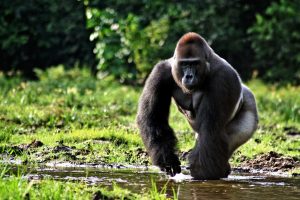
Western gorillas are large, powerful primates, although they are generally smaller and more slender than eastern gorillas. Adult males are considerably larger than females and develop the characteristic silver hair across their backs as they mature. These mature males are commonly called silverbacks.
The colour of western gorilla hair can vary from dark brown to black, with mature males often developing grey or silver colouring across their backs and shoulders. Western lowland gorillas can sometimes have a reddish or brownish appearance on parts of the body, particularly when viewed under certain lighting conditions.
One noticeable characteristic of western gorillas is their relatively broad skull and pronounced brow ridge. Their powerful jaws and large teeth are adapted to their mainly plant-based diet.
Their arms are longer and more muscular than their legs, making them highly suited to moving through dense vegetation and climbing when necessary. On the ground, western gorillas commonly move using a form of knuckle-walking, supporting part of their weight on their hands.
Despite their enormous physical strength, gorillas are generally peaceful animals when left undisturbed. Much of their daily life revolves around feeding, resting, travelling and maintaining social relationships.
Difference Between Western Gorillas and Eastern Gorillas
There are several important differences between western and eastern gorillas. Both belong to the Gorilla genus, but they occupy different geographical regions and include different subspecies.
Geographical Distribution
The first major difference is their geographical distribution. Western gorillas are primarily found in the forests of Central and West-Central Africa, including Gabon, the Republic of Congo, Cameroon, Equatorial Guinea and the Central African Republic. Cross River gorillas occur in a small area of Nigeria and Cameroon.
Eastern gorillas are found farther east. The two eastern subspecies are the Mountain Gorilla, Gorilla beringei beringei, and the Eastern Lowland Gorilla, also known as Grauer’s gorilla, Gorilla beringei graueri.
Mountain gorillas live in the Virunga region shared by Uganda, Rwanda and the Democratic Republic of Congo, as well as Bwindi Impenetrable National Park in Uganda. Grauer’s gorillas are found in eastern DR Congo.
Body Size and Appearance
Western and eastern gorillas also have some physical differences. Western lowland gorillas are generally smaller than eastern gorillas, particularly when compared with the large Grauer’s gorilla.
These gorillas can also have a somewhat reddish or brownish colouring to parts of their hair, while eastern gorillas are often characterized by darker coats. However, colour should not be treated as the only way to distinguish them because individual animals can vary considerably.
Facial and Skull Features
Another difference can be seen in their facial and skull characteristics. Western gorillas generally have broader skulls, while eastern gorillas have somewhat different facial proportions. The most reliable way to distinguish the groups is their geographical location, physical characteristics and scientific classification rather than relying on one feature such as hair colour.
Habitat
Western gorillas are primarily associated with lowland tropical rainforests, swamp forests and other dense forest habitats. Mountain gorillas live at much higher elevations in montane forests and bamboo zones. This difference in habitat has resulted in different physical and behavioural adaptations.
Social Life of Western Gorillas
Western gorillas are highly social animals. They usually live in groups that may contain a dominant silverback, adult females, younger males and infants.
The silverback generally plays an important role in protecting the group and determining its movements. He may also intervene during conflicts and protect members of the group from potential threats.
Females may form strong relationships with other members of the group, while young gorillas spend considerable time playing and learning social behaviour.
Gorilla communities are not completely fixed. Individuals can leave one group and join another, particularly as they mature. Young males may eventually leave their birth groups and live independently or form their own groups.
Communication is also an important part of gorilla life. Gorillas use vocalizations, facial expressions, body postures and physical contact to communicate with one another.
Visitors who encounter gorillas in the forest may therefore observe a wide range of behaviours, from feeding and resting to grooming, playing and communicating.
What Do Western Gorillas Eat?
Western gorillas are mainly herbivores. Their diet consists largely of leaves, stems, shoots, bark, flowers, roots and fruits.
Western lowland gorillas often consume considerable quantities of fruit when it is available. This makes their diet somewhat different from that of mountain gorillas, whose high-altitude environment provides fewer fruits during many periods of the year.
Gorillas spend a large part of the day feeding because their bodies require considerable amounts of food to maintain their strength and size.
Their feeding behaviour also contributes to the wider forest ecosystem. By consuming plants and moving through the forest, gorillas can influence vegetation and contribute to seed dispersal when they consume fruits.
Trekking Western Gorillas
Gorilla trekking is one of the most exciting wildlife activities in Africa, but the experience differs considerably depending on the gorilla species and destination.
For travellers interested in western lowland gorillas, one of the most notable destinations is Odzala-Kokoua National Park in the Republic of Congo. The park is located within the Congo Basin and contains extensive tropical rainforest, forest clearings and diverse wildlife.
The park is famous for its rich biodiversity and provides opportunities to encounter western lowland gorillas as well as other forest animals.
Visitors undertaking gorilla tracking are accompanied by trained guides, trackers and park staff. The trackers use signs such as nests, footprints, feeding remains and other evidence to determine where the gorillas have moved.
The experience can involve several hours of walking through dense forest. The terrain may be challenging, particularly after rainfall, so visitors need a reasonable level of physical fitness and appropriate hiking equipment.
Finding the gorillas is only one part of the experience. The journey through the Congo Basin provides opportunities to observe forest vegetation, birds, insects and other wildlife.
Once the gorillas are located, visitors are expected to follow the instructions of guides and maintain appropriate distances and behaviour around the animals. Photography is generally permitted subject to park rules, but flash photography and other forms of disturbance should be avoided.
Accommodation During a Western Gorilla Safari
A western gorilla safari can be combined with comfortable accommodation in or near the forest. In Odzala-Kokoua, accommodation options include camps designed to provide visitors with access to the surrounding wilderness.
Mboko Camp and Lango Camp are among the accommodation options associated with the Odzala experience. Staying in these types of camps allows visitors to spend more time within the forest environment rather than travelling long distances each day.
The accommodation experience can itself become part of the adventure. Visitors may enjoy meals surrounded by nature, listen to forest sounds in the evening and wake up to birds calling in the surrounding vegetation.
Cost of Western Gorilla Trekking
The cost of a western gorilla experience varies depending on the destination, season, safari package, accommodation, transportation and services included.
It is therefore important for prospective travellers to check the current permit and package costs before planning their trip. Unlike mountain gorilla tourism in Uganda and Rwanda, western lowland gorilla experiences in the Republic of Congo may be organized as part of specialized safari packages, with costs depending on the operator and the particular camp or park experience.
Travellers should also consider additional expenses such as international flights, domestic or charter flights, accommodation, park fees, transfers, meals, guide services and other activities.
Because gorilla safaris often involve limited visitor capacity and remote destinations, early planning is recommended. Booking in advance gives travellers more flexibility when choosing travel dates and accommodation.
Best Time to Visit Western Gorillas
The climate of the Congo Basin is generally tropical and humid, with rainfall occurring during much of the year. However, rainfall patterns vary depending on the exact location.
For travellers visiting Odzala-Kokoua National Park, certain periods can provide better conditions for forest activities and wildlife viewing. The drier periods are often preferred because trails can be easier to navigate and some wildlife may gather around forest clearings.
July and August are commonly considered among the more favourable months for visiting parts of the Congo Basin. December and January can also provide opportunities for travel, although conditions vary from year to year.
It is important to understand that there is no guarantee of completely dry weather in a rainforest environment. Rain can occur at any time, and visitors should always be prepared for wet conditions.
The advantage of visiting during a wetter period is that the forest can be particularly lush and vibrant. Rainfall contributes to the spectacular greenery that makes the Congo Basin so unique.
Conservation of Western Gorillas
Western gorilla conservation remains an important international concern. Western lowland gorillas are classified as Critically Endangered, while Cross River gorillas are also among the world’s most threatened great apes.
Several factors contribute to their decline. Habitat destruction reduces the amount of forest available to wildlife, while hunting can directly reduce gorilla populations. Disease is another serious concern because gorillas are susceptible to some diseases that can also affect humans. Conservation organizations, national governments, researchers and local communities continue to work together to protect gorilla habitats and reduce threats.
Tourism can also contribute to conservation when it is carefully managed. Gorilla tracking provides employment for guides, trackers and other tourism workers while generating revenue that can support protected areas and surrounding communities. Responsible tourism is therefore an important part of the long-term conservation story. Visitors should follow park regulations, respect wildlife and avoid actions that could disturb or endanger the gorillas.
Experience Western Gorillas in the Congo Basin
Western gorillas are among Africa’s most remarkable great apes. Their intelligence, social behaviour, impressive physical strength and close evolutionary relationship with humans make them fascinating animals to observe and study.
From the dense rainforests of the Congo Basin to the restricted habitat of the Cross River gorilla, these animals remain an important part of Africa’s natural heritage.
A western gorilla safari offers much more than simply seeing a gorilla. It is an opportunity to enter one of the world’s great tropical rainforest ecosystems, discover unique wildlife and learn about the importance of protecting these forests for future generations.
If you are planning to visit western gorillas, proper preparation is essential. Choosing the right season, arranging permits and park access in advance, selecting suitable accommodation and travelling with an experienced safari operator can make the experience more enjoyable.
Whether your interest is wildlife photography, primate research, conservation, adventure or simply experiencing one of Africa’s most extraordinary forests, a western gorilla safari can provide an unforgettable journey into the Congo Basin.