Mountain Gorillas in Africa
Mountain gorillas are one of Africa’s most remarkable great apes and one of the most sought-after wildlife experiences in the world. These magnificent primates are among the rarest mammals on the continent and cannot be easily encountered in the wild. Unlike many other wildlife species that inhabit open savannahs and can often be spotted during game drives, mountain gorillas live deep within highland forests where the terrain can be steep, rugged and covered with dense vegetation.
Mountain gorillas belong to the Eastern Gorilla species, with their scientific name being Gorilla beringei beringei. They are a subspecies of the Eastern Gorilla and are adapted to life in high-altitude forests. Their thick, long hair helps them cope with the cool temperatures found in their mountainous habitat. This adaptation is one of the reasons they are commonly known as mountain gorillas.
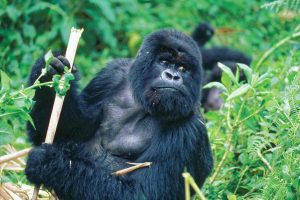
The mountain gorillas have one of the most restricted ranges of any great ape. They are found in only two geographically separate populations. One population lives in the Virunga Massif, a chain of volcanic mountains shared by Uganda, Rwanda and the Democratic Republic of Congo. The other population lives in Uganda’s Bwindi Impenetrable National Park and the adjoining Sarambwe Nature Reserve in the Democratic Republic of Congo. Today, just over 1,000 mountain gorillas are estimated to survive in the wild.
The Virunga Mountains and Mountain Gorilla Habitat
The Virunga Massif is one of the most important landscapes for mountain gorilla conservation. The name Virunga is associated with the chain of volcanic mountains that dominates the landscape of the region. These volcanoes stretch across the borders of Uganda, Rwanda and the Democratic Republic of Congo and provide a unique combination of montane forest, bamboo vegetation, open alpine areas and volcanic slopes.
The best-known volcanoes in the Virunga region include Mount Sabyinyo, Mount Gahinga, Mount Muhabura, Mount Bisoke, Mount Karisimbi, Mount Nyiragongo, Mount Nyamuragira and Mount Mikeno. Not all of these mountains are located entirely within the same country, but together they form part of the larger volcanic landscape in which mountain gorillas have evolved.
Three protected areas within the Virunga Massif are particularly important for mountain gorillas. These are Mgahinga Gorilla National Park in Uganda, Volcanoes National Park in Rwanda and Virunga National Park in the Democratic Republic of Congo. The mountain gorilla population in this landscape moves through forested habitats across an ecosystem that crosses international boundaries.
Uganda also protects another important mountain gorilla population in Bwindi Impenetrable National Park. Bwindi is not part of the Virunga volcanic chain, although it supports a separate mountain gorilla population. The Bwindi population is particularly important because it represents one of the two remaining populations of mountain gorillas in the world.
Mountain Gorilla Population and Conservation Status
Mountain gorillas were once considered to be on the brink of extinction. Decades of habitat pressure, hunting, disease, political instability and other human-related threats placed enormous pressure on their survival. Intensive conservation efforts, however, have helped their numbers recover.
The population has now grown to just over 1,000 individuals in the wild. This represents a remarkable conservation achievement considering that historical estimates placed the population at considerably lower levels. A 2018 census recorded 1,004 mountain gorillas, while the 2018 Bwindi-Sarambwe survey subsequently contributed to a combined estimate of 1,063 individuals when added to the earlier Virunga Massif census. More recent conservation organizations continue to describe the global population as just over 1,000.
There is an important correction to the older description of mountain gorillas as critically endangered. The subspecies was downlisted by the International Union for Conservation of Nature (IUCN) from Critically Endangered to Endangered in 2018, following decades of conservation work and population growth. This does not mean that mountain gorillas are safe from extinction. Their population remains extremely small, and they continue to face threats that require constant conservation attention.
Conservation organizations, governments, veterinarians, researchers, park authorities and local communities all play important roles in protecting mountain gorillas. Veterinary teams such as Gorilla Doctors provide medical care to sick and injured habituated gorillas, while park authorities monitor gorilla groups, protect their habitats and regulate tourism.
The success of mountain gorilla conservation demonstrates the importance of combining wildlife protection with scientific research, responsible tourism and support for communities living around protected areas.
Interesting Facts About Mountain Gorillas
Mountain gorillas have many characteristics that make them fascinating to visitors and researchers. Their physical appearance, family structure, intelligence and close genetic relationship with humans have made them one of Africa’s most studied great apes.
Where Do Mountain Gorillas Live?
Mountain gorillas live in only a small part of Central and East-Central Africa. Their two populations are found in Uganda, Rwanda and the Democratic Republic of Congo.
In Uganda, visitors can track mountain gorillas in Bwindi Impenetrable National Park and Mgahinga Gorilla National Park. Bwindi is divided into four major trekking sectors: Buhoma, Ruhija, Rushaga and Nkuringo. Mgahinga, meanwhile, forms part of the greater Virunga ecosystem and provides another opportunity to encounter these remarkable primates.
In Rwanda, mountain gorilla trekking takes place in Volcanoes National Park. In the Democratic Republic of Congo, Virunga National Park is home to part of the Virunga Massif population.
Mountain Gorillas Live in Family Groups
Mountain gorillas have a highly social way of life. They normally live in groups or families that are led by one or more adult males. The dominant silverback plays an important role in protecting the group, controlling movements, resolving conflicts and defending females and young gorillas against potential threats.
A silverback is an adult male whose back and shoulders develop a distinctive silvery-grey coloration as he matures. Although the dominant silverback is generally the principal leader, some mountain gorilla groups can contain more than one adult male. This makes their social structure more complex than simply having one male in every family.
Gorilla families can change over time. Young males may leave their natal groups and become solitary or join other males, while females may transfer between groups. Groups can also split or merge depending on social and environmental circumstances.
Mountain Gorillas Have Long Lifespans
Mountain gorillas can live for several decades in the wild. Their lifespan can exceed 40 years, although individual longevity varies depending on health, injuries, disease, environmental conditions and other factors. Females generally mature earlier than males and play an important role in raising infants. Gorilla mothers form strong bonds with their young, and infants remain dependent on their mothers for an extended period. The close relationship between mothers and infants is one of the most memorable aspects of a gorilla trekking experience. Visitors may observe mothers carrying babies, grooming them, feeding them or allowing them to play within the family group.
Mountain Gorillas Are Closely Related to Humans
Mountain gorillas share more than 98% of their DNA with humans, demonstrating their close evolutionary relationship with us. This genetic similarity also means that gorillas can be vulnerable to some diseases that affect humans. For this reason, gorilla trekking regulations are not only designed to protect tourists but also to protect the gorillas. Visitors who are sick may be restricted from visiting gorilla groups, and tourists are expected to maintain an appropriate distance and follow instructions from guides and park authorities. The relationship between human health and gorilla health is one of the reasons responsible tourism is so important in mountain gorilla conservation.
Mountain Gorillas Spend Much of Their Day Feeding
Mountain gorillas spend a considerable amount of their day searching for and eating vegetation. Their diet consists mainly of leaves, stems, shoots, flowers, bark and other plant material. Depending on the habitat and availability of food, they may also consume small invertebrates.
Their large bodies require substantial amounts of food, and their powerful jaws and digestive systems allow them to process large quantities of fibrous vegetation. Unlike predators that need to chase and kill prey, gorillas spend much of their active time moving through the forest and feeding. Visitors on a gorilla trek may therefore find a family feeding on vegetation, resting after feeding or slowly moving through the forest.
Mountain Gorillas Communicate Through Different Sounds
Mountain gorillas have an impressive range of vocalizations and body signals. Communication is important for maintaining relationships within the group, expressing alarm, showing aggression, attracting attention and maintaining social order.
They may grunt, bark, hoot, scream or make other vocalizations. Chest beating is perhaps their most famous form of communication, although it does not always represent aggression. A gorilla may beat its chest during displays, excitement, social interactions or when responding to another gorilla. Their communication also involves facial expressions, body posture, gestures and physical contact such as grooming.
How Different Are Mountain Gorillas From Other Gorilla Subspecies?
Mountain gorillas are one of four recognized gorilla subspecies. The other three are the Eastern Lowland or Grauer’s Gorilla, the Western Lowland Gorilla and the Cross River Gorilla.
Mountain gorillas are particularly distinctive because of their habitat and physical adaptations. They have relatively long and thick hair compared with lowland gorillas. This dense coat helps them cope with the cooler temperatures of the high-altitude forests where they live.
Their habitat is also a major difference. Western Lowland Gorillas and Cross River Gorillas live in the forests of Central and West-Central Africa, while Grauer’s Gorillas inhabit forests of eastern Democratic Republic of Congo. Mountain gorillas, in contrast, are restricted to the high-altitude forests of the Virunga Massif and the Bwindi-Sarambwe ecosystem.
Mountain gorilla groups can also contain multiple adult males. A group may have a dominant silverback together with subordinate silverbacks or younger blackback males. The dominant male generally has the strongest influence over the group’s movements and social activities. Another important difference is their limited geographical range. Mountain gorillas occupy a very small area compared with Western Lowland Gorillas, which have a much wider distribution across the Congo Basin.
Trekking the Mountain Gorillas
Gorilla trekking is the most popular activity associated with mountain gorillas. It involves hiking through the forest in search of a habituated gorilla family. Unlike a traditional game drive where tourists remain in a vehicle, gorilla trekking requires visitors to walk through dense vegetation and sometimes steep terrain.
The trek may take several hours depending on where the gorilla family has moved. In Uganda, the Uganda Wildlife Authority notes that gorilla treks can last approximately two to seven hours, including the time spent tracking the animals, while the actual viewing period with the habituated family is limited to one hour for normal trekking.
The difficulty of the trek varies considerably. Some families may be located relatively close to the trailhead, while others can require several hours of hiking. Visitors should therefore prepare for muddy trails, steep slopes, thick vegetation, rain and changing weather conditions.
It is not correct to describe mountain gorillas as naturally “rude.” They are wild animals and can be defensive when they feel threatened, but habituated gorilla families have become accustomed to the presence of people under carefully controlled conditions. Rangers and guides accompany tourists throughout the experience and ensure that visitors follow established regulations.
The guides and trackers also play an important role in locating the gorillas. Gorilla families do not remain in one place. They move through the forest every day in search of food, resting areas and suitable locations for their night nests. Trackers often leave early to locate the family’s position before visitors arrive.
Gorilla trekking also requires reasonable physical preparation. Uganda Wildlife Authority describes the activity as requiring moderate fitness, although the actual difficulty depends on the location of the gorilla family and the terrain on the day.
Visitors should carry suitable hiking shoes, long trousers, a waterproof jacket, drinking water, snacks, gardening gloves and other practical items. Hiring a porter is also encouraged because porters can assist with luggage and provide support on difficult sections of the trail while contributing directly to the local economy.
Cost of Trekking Mountain Gorillas
The cost of a mountain gorilla trek varies depending on the country and visitor category. The main requirement is a valid gorilla trekking permit, which allows a visitor to participate in the regulated gorilla tracking experience.
In Uganda, the current Uganda Wildlife Authority tariff covering July 2024 to June 2026 lists a normal gorilla tracking permit at US$800 for foreign non-residents, US$700 for foreign residents and UGX 300,000 for East African citizens. These rates include the guide fee, park entrance fee for the day and a community development contribution.
Uganda also offers a Gorilla Habituation Experience in Bwindi, which provides a longer experience with a gorilla group that is being habituated. The same UWA tariff lists this experience at US$1,500 for foreign non-residents, US$1,000 for foreign residents and UGX 750,000 for East African citizens.
For foreign non-residents, that gorilla permits must be purchased through tour operators licensed by the Uganda Tourism Board. This is an important consideration when arranging a gorilla safari in Uganda.
In Rwanda, the standard mountain gorilla trekking permit for a foreign visitor is US$1,500. Rwanda also has different rates for Rwandan citizens, East African citizens and certain residents, with promotional conditions applying at particular times. The official Rwanda Development Board booking platform currently states that promotional rates are not applicable during June to October 2026.
In the Democratic Republic of Congo, gorilla trekking arrangements and availability can vary according to security conditions and park operations. Visitors planning to trek in Virunga National Park should therefore confirm the latest permit prices, operating conditions and travel requirements before making arrangements.
Permit prices can change, so travelers should always confirm current tariffs with the relevant wildlife authority or a licensed tour operator before booking.
What is the Best Time to Visit for Mountain Gorilla Trekking
Mountain gorilla trekking is possible throughout the year because the gorillas live in their natural forest habitat and do not migrate seasonally. However, weather conditions can influence the trekking experience.
The traditional dry seasons are generally considered more convenient for trekking. In the region, these commonly occur around June to September and December to February. During these periods, trails can be less muddy and hiking conditions may be more manageable. However, rain can occur at any time because mountain gorillas live in tropical highland forests. Even during the dry season, visitors should be prepared for rainfall. Bwindi, in particular, is a rainforest environment where weather conditions can change quickly.
The wetter months can also provide a rewarding experience. The forests are lush and green, and rainfall contributes to abundant vegetation. Since gorillas depend heavily on plants for food, their habitat remains productive throughout the year. For travelers primarily concerned with hiking conditions, the drier periods are often preferred. Those who have more flexible travel schedules can also consider the wetter months, particularly if they are comfortable with muddy trails and occasional rainfall.
Ultimately, there is no single month that guarantees an easier or more successful gorilla trek. The gorillas are wild animals, and their location changes from day to day. What makes the experience special is the opportunity to enter their natural habitat and observe them responsibly under the guidance of trained trackers and rangers.
Mountain Gorilla Trekking as a Conservation Experience
A mountain gorilla trek is much more than a wildlife encounter. It is part of a conservation system that has helped protect one of the world’s rarest great apes.
Tourism revenue supports protected-area management, conservation programs, park staff and communities around gorilla habitats. The presence of regulated tourism also creates an economic reason to maintain forests and protect gorillas. The recovery of the mountain gorilla population demonstrates what long-term conservation can achieve. The species remains vulnerable, but the increase from historical population levels to more than 1,000 individuals is an important achievement. Conservation organizations continue to monitor gorilla health, protect their habitat and work with communities to reduce threats.
For travelers planning a Uganda, Rwanda or Democratic Republic of Congo safari, mountain gorilla trekking offers an opportunity to experience one of Africa’s most extraordinary wildlife encounters while contributing to the continued protection of these remarkable animals.
The forests of Bwindi, Mgahinga and the Virunga Massif remain among the most important habitats for mountain gorillas. Visiting responsibly, following park regulations and choosing legitimate tourism operators all help ensure that gorilla tourism continues to support conservation and the communities that live alongside these endangered great apes.