Bonobos: The Fascinating Pygmy Chimpanzees of the Democratic Republic of Congo
Did you know that bonobos are sometimes known as pygmy chimpanzees? Bonobos are one of the world’s most fascinating great apes and are among our closest living relatives. They share approximately 98.7% of their DNA with humans, making them remarkably close to us from an evolutionary perspective. Unlike chimpanzees, however, bonobos are found naturally only in the Democratic Republic of Congo (DR Congo), where they live in the forests south of the Congo River.
The name “bonobo” has been associated with several possible origins, although its exact linguistic origin is not completely certain. Rather than simply describing them as “dwarf pygmies,” it is more accurate to explain that bonobos are a distinct species of great ape that is generally smaller and more slender than common chimpanzees. Their scientific name is Pan paniscus, while the common chimpanzee is Pan troglodytes.
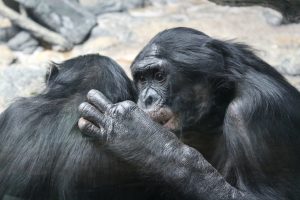
Bonobos are classified as Endangered, meaning they face a very high risk of extinction in the wild. Their restricted distribution makes them particularly vulnerable because the entire wild population occurs within DR Congo. Habitat destruction, hunting, the illegal wildlife trade and other human pressures continue to threaten their survival. The IUCN Red List uses factors such as population decline, habitat loss and the size of a species’ geographic range when assessing extinction risk.
Where Can Bonobos Be Found?
Wild bonobos are found only in the forests of the Democratic Republic of Congo, particularly in the extensive tropical forests south of the Congo River. This geographical separation from chimpanzees is one of the most interesting aspects of their distribution. Although bonobos and chimpanzees are closely related, the Congo River has played an important role in separating their natural ranges.
For visitors interested in seeing these remarkable primates, one of the best-known places is Lola ya Bonobo Sanctuary, located near Kinshasa. The sanctuary provides a protected environment for rescued bonobos and plays an important role in education, research and conservation. It has become an important destination for people who want to learn about bonobos and understand the challenges facing them in the wild.
The sanctuary also gives visitors an opportunity to observe bonobo behaviour at relatively close range while learning about the importance of protecting the forests where wild populations live. Conservation centres such as Lola ya Bonobo are particularly important because the survival of bonobos depends not only on protecting individual animals but also on protecting their natural forest habitat.
Bonobos Compared to Chimpanzees
At first glance, bonobos and chimpanzees can look very similar. They are both members of the Pan genus and are closely related to humans. However, there are several physical and behavioural differences between them.
Bonobos are generally more slender than chimpanzees, with longer legs, narrower shoulders and a more upright posture. They often appear to have a more graceful body shape, particularly when walking on two legs. Their faces are generally darker, and they have a characteristic hairstyle in which the hair is parted from the forehead backwards.
Adult bonobos vary considerably in weight, but males are generally heavier than females. Their bodies are adapted to life both in the forest canopy and on the ground. Like chimpanzees and gorillas, bonobos commonly use a form of quadrupedal movement known as knuckle-walking, but they are also capable of walking upright on two legs for short periods.
Their behaviour is perhaps even more interesting than their appearance. Bonobos are well known for their highly social communities and for the important role that relationships play within their groups. They are often described as living in female-dominated societies, although researchers increasingly recognize that their social structure is more complicated than a simple “females are in charge” description.
Recent research published in 2025 found evidence that female bonobos can form coalitions with one another, often involving several females working together, which can help them maintain social power over males. Researchers studying six wild bonobo communities over several decades found that these female alliances were an important part of the species’ social organization.
Bonobo Social Life and Communication
Bonobos are extremely social animals. Their communities can contain dozens of individuals, although the number present together at any particular moment may vary. Instead of remaining in one large group throughout the day, they have what scientists describe as a fission-fusion social structure. This means that a larger community can split into smaller parties while searching for food and later come together again.
Some communities studied in the wild have contained approximately 25 to 75 individuals, although group size can vary. During the day, smaller groups may travel through the forest searching for fruits, leaves and other foods. At night, they come together to rest and construct sleeping nests in trees.
Bonobos have a sophisticated system of communication involving vocalizations, facial expressions, gestures and body movements. They can use gestures to request food, initiate social interactions, show submission or communicate other intentions. Their ability to communicate through a combination of sounds and physical gestures is one reason scientists are interested in studying them.
Bonobos have also been involved in research examining the cognitive abilities of great apes. Some captive bonobos have demonstrated impressive abilities in understanding symbols, responding to human instructions and using tools. These studies do not mean that bonobos speak human languages in the same way people do, but they do demonstrate remarkable cognitive and communication abilities.
Why Are Bonobos Known for Peaceful Behaviour?
Bonobos have earned a reputation for being more peaceful and tolerant than chimpanzees. Their communities often use social contact to reduce tension and maintain relationships. Sexual behaviour is one of the behaviours for which bonobos are particularly famous, and scientists have documented sexual interactions that occur in social contexts beyond reproduction.
Researchers believe that these interactions can play a role in maintaining social bonds and reducing tension, although bonobo behaviour should not be reduced to the popular idea that they simply “solve every problem with sex.” Their social lives are much more complicated than this simplified description.
Bonobos can still display aggression. They are not completely peaceful animals, and serious conflicts can occur, particularly when different communities encounter each other. Therefore, it is more accurate to describe bonobos as having a social system that tends to promote tolerance and cooperation within communities rather than saying that they never fight.
What Do Bonobos Eat?
Bonobos are primarily fruit eaters, making fruits an important part of their diet. However, they are not strictly dependent on fruit. They also consume leaves, seeds, flowers, bark, honey and other plant materials. Their diet can change depending on what is available in the forest at different times of the year.
They can also consume invertebrates and, on occasion, small vertebrates. This varied diet allows bonobos to make use of different food resources within their forest environment.
Their feeding habits also give them an important ecological role. When bonobos eat fruits and later move through the forest, they can disperse seeds in different locations. Seed dispersal is an important natural process because it contributes to forest regeneration and helps plants reproduce away from their parent trees.
This means that protecting bonobos is also connected to protecting the wider forest ecosystem. When an important fruit-eating species disappears, there can be consequences for the plants and ecological processes that depend on it.
Bonobo Reproduction and Young Ones
Bonobos do not have a short, clearly defined mating season in the way that some other mammals do. Females can reproduce throughout the year, and reproduction is closely connected to the complex social relationships within their communities.
The gestation period is approximately eight months, after which a female normally gives birth to a single infant. Newborn bonobos are highly dependent on their mothers. Young infants spend a great deal of time clinging to their mothers, particularly during the early stages of life.
The relationship between mothers and their offspring is extremely important in bonobo society. Research has even shown that mothers can have a significant influence on the reproductive success of their adult sons. One study found that mothers may assist their sons during interactions with potential mates and can help protect their sons from competing males.
Bonobos mature slowly, like other great apes, and young individuals remain socially connected to their families for many years. This long period of development gives young bonobos considerable time to learn social behaviour, feeding skills and communication from older members of their communities.
Bonobo Nests and Life in the Forest
Like chimpanzees, bonobos build sleeping nests, usually in trees, where they spend the night. Nest construction is an important part of their daily routine. A bonobo can select branches and vegetation to create a comfortable platform where it can rest safely above the forest floor.
Living in the trees offers protection from some dangers on the ground, while also providing access to important food resources. During the day, however, bonobos may travel on the forest floor as they move between feeding areas.
Bonobos are also capable climbers and move easily through the forest canopy. Their long limbs and flexible bodies allow them to climb, swing and move between branches. Watching wild bonobos moving through the trees provides a remarkable insight into how well adapted they are to their forest environment.
Bonobos and Water
Another interesting characteristic of bonobos is their relationship with water. Compared with common chimpanzees, bonobos are generally considered less reluctant to enter water. They have been observed near streams and other water sources, and some individuals can enter shallow water while searching for food.
This is another reminder that bonobos should not simply be considered smaller versions of chimpanzees. Although the two species share a close evolutionary relationship, they have developed different behavioural and social characteristics.
Threats Facing Bonobos
Despite their fascinating behaviour and close relationship with humans, bonobos face serious conservation challenges.
One of the biggest threats is habitat loss. The forests where bonobos live are affected by human activities, including agricultural expansion, settlement and other forms of forest exploitation. As forests become fragmented, bonobo communities can become isolated from one another.
Hunting is another major concern. Bonobos have historically been affected by bushmeat hunting, while young individuals may also become victims of the illegal wildlife trade. Because bonobos reproduce relatively slowly, the loss of adults can have serious consequences for the long-term survival of a population.
Political instability and insecurity in parts of DR Congo can also make conservation work difficult. Protecting forests and wildlife requires long-term cooperation between local communities, conservation organizations, researchers and government authorities.
Conservation efforts therefore need to focus on more than protecting bonobos inside sanctuaries. Protecting the forests where wild bonobos live is essential. Education, responsible tourism, habitat protection and stronger action against illegal hunting and wildlife trafficking all have important roles to play.
When to See Bonobos
Bonobos can be seen throughout the year at Lola ya Bonobo Sanctuary, making it possible to include a bonobo experience in a Democratic Republic of Congo travel itinerary during different seasons.
The climate around Kinshasa includes distinct wetter and drier periods. Generally, the drier months can provide more comfortable conditions for visitors because heavy rainfall can make some outdoor activities more challenging. However, weather patterns can vary, and visitors should check current local conditions when planning their trip.
A visit to Lola ya Bonobo is more than simply an opportunity to see an unusual primate. It provides a chance to learn about one of humanity’s closest living relatives and understand the conservation challenges facing bonobos in their natural environment.
For travellers interested in primates, wildlife, conservation and unique African experiences, a visit to the sanctuary can be a memorable addition to a Democratic Republic of Congo adventure.
Visit the Home of the Bonobos
Bonobos are among the most fascinating great apes on Earth. Their intelligence, social relationships, communication skills, distinctive appearance and complex community structure make them particularly interesting to wildlife lovers and researchers alike.
Although they are closely related to chimpanzees and humans, bonobos have developed their own unique way of life. Their survival, however, depends on the protection of the forests of the Democratic Republic of Congo and continued conservation efforts.
For the best memorable experience with these remarkable “pygmy chimpanzees,” contact us. We are ready to help you discover Lola ya Bonobo Sanctuary and learn more about one of Africa’s most extraordinary and endangered great apes.