Western Chimpanzees: Facts, Trekking, Cost and Best Time to Visit
Western chimpanzees are one of the most fascinating chimpanzee populations in Africa. They inhabit western Africa and are scientifically recognised as the Western chimpanzee, Pan troglodytes verus, one of the recognised subspecies of the common chimpanzee. These remarkable primates share many characteristics with humans, making them among the most interesting animals to encounter during a wildlife or primate safari in West Africa.
Chimpanzees are among our closest living relatives, sharing a very high proportion of their genetic material with humans. Their sophisticated social lives, communication abilities, use of tools, hunting techniques and problem-solving skills have attracted scientists and wildlife enthusiasts for many years. Western chimpanzees are particularly interesting because they have developed unique behaviours in response to the environments in which they live.
The Western chimpanzee’s historical range covered a large part of West Africa. Today, however, their populations are increasingly fragmented because of habitat loss, hunting, agriculture, human settlement and other pressures. Important populations can still be found in countries such as Senegal, Guinea, Guinea-Bissau, Sierra Leone, Liberia, Côte d’Ivoire and Ghana, although their distribution and population sizes vary considerably from one country to another.
Côte d’Ivoire is considered one of the important remaining strongholds for Western chimpanzees, while other populations survive in protected forests and national parks across the region. Senegal is also particularly important because chimpanzees living in the dry woodland and savannah landscapes of southeastern Senegal have demonstrated fascinating behaviours that differ from those observed in some of their counterparts living in wetter forests.
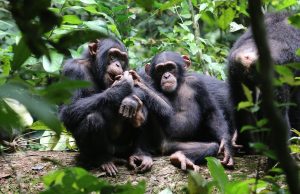
Interesting Facts About Western Chimpanzees
Western chimpanzees have many interesting characteristics that make them a major attraction for primate enthusiasts. Although some of the behaviours mentioned below may also occur among other chimpanzee populations, Western chimpanzees have developed several distinctive behaviours that make them especially interesting to researchers and visitors.
Western chimpanzees have a varied diet
Western chimpanzees are not strictly carnivores. They are omnivores, meaning that their diet consists of both plant and animal foods. Fruits are an important part of their diet, together with leaves, seeds, flowers, bark and other plant materials. Depending on the habitat and season, they may also eat insects, eggs and small vertebrates.
Chimpanzees are also known for hunting other mammals. In some parts of West Africa, they have been observed hunting animals such as bush babies and monkeys. These hunting behaviours demonstrate their ability to cooperate, plan and respond to the movements of their prey.
Hunting is particularly interesting because it shows that chimpanzees are capable of adapting their behaviour according to available food resources. Their diet is therefore not simply determined by what grows in the forest but can also involve active searching and hunting.
Males and females can have different feeding behaviours
One of the fascinating aspects of Western chimpanzee behaviour is the variation in feeding and hunting patterns between males and females. Research on chimpanzees in Senegal has documented differences in hunting behaviour between the sexes, including differences in the types and frequency of prey pursued.
For example, observations of Senegalese chimpanzees have shown that females can make significant contributions to hunting, challenging older assumptions that hunting is primarily a male activity. This demonstrates how flexible chimpanzee societies can be and how behaviour can differ depending on habitat, food availability and social circumstances.
These differences are also a reminder that chimpanzees should not be viewed as behaving exactly the same way across Africa. Different communities can develop their own traditions and behavioural patterns.
Western chimpanzees use and manufacture tools
One of the most impressive characteristics of chimpanzees is their ability to use tools. Western chimpanzees have been observed selecting, modifying and using objects for different purposes.
In some communities, chimpanzees use sticks and other plant materials to obtain food. They can modify branches, strip leaves or adjust tools according to the task they are attempting to accomplish. Some Western chimpanzee populations are also known for using wooden tools during hunting.
The use of tools demonstrates remarkable problem-solving abilities. A chimpanzee does not simply pick up a random object and use it; in many cases, the animal selects an appropriate material and modifies it to suit a particular purpose.
This is one of the reasons chimpanzee behaviour has been so important to scientists studying the evolution of intelligence, culture and technology among primates.
They use stones and objects in fascinating ways
Western chimpanzees can also display unusual object-related behaviours. Some communities have been observed throwing stones and other objects toward trees or particular locations.
In Senegal, researchers have documented distinctive stone-throwing and stone-accumulating behaviours in some chimpanzee communities. The exact meaning of these behaviours is still an area of scientific interest, and researchers have proposed several possible explanations.
Such observations demonstrate that chimpanzee behaviour can include traditions that are learned and passed between generations. This is particularly important because it suggests that chimpanzee communities can develop their own local behavioural cultures.
They can cool themselves in water
Chimpanzees living in hot environments may interact with water in several ways. They may drink from streams, bathe, wade through shallow water or play in water when conditions allow.
For Western chimpanzees living in some of the warmer landscapes of West Africa, water can be an important environmental resource. Watching chimpanzees interact with water can be an entertaining part of a wildlife experience, especially when animals are relaxed and displaying playful behaviour. Their interaction with water also demonstrates their ability to adapt to different environmental conditions.
They are intelligent and highly social animals
Chimpanzees live in complex societies known as communities. These communities can contain many individuals, but the animals frequently divide into smaller temporary groups known as parties.
The composition of these parties can change throughout the day depending on food availability, social relationships and other circumstances. Individuals recognize one another and maintain long-term relationships.
Chimpanzees communicate using vocalizations, facial expressions, body postures and gestures. They can also groom one another, play together, form alliances and cooperate in different activities. Their social relationships are one of the reasons chimpanzees are considered such fascinating animals to observe in the wild.
Some Western chimpanzees use caves and rocky shelters
One of the more unusual behaviours recorded among some Western chimpanzees, particularly in Senegal, is their use of caves and rocky shelters. In areas where temperatures can become extremely high, caves can provide shade and protection from the sun.
This behaviour is sometimes compared with the way humans have historically used caves as shelters. However, it is important to understand that chimpanzees do not generally live permanently inside caves in the same way that humans once used caves as homes. Instead, certain communities may use caves or rocky areas as resting places or shelters. This behaviour is nevertheless remarkable because it shows how chimpanzees can adapt their behaviour to challenging environmental conditions.
What Differentiates Western Chimpanzees from Other Chimpanzees?
Western chimpanzees belong to the same species as the other recognized chimpanzee subspecies, Pan troglodytes. Therefore, they should not be described as a completely separate species from other chimpanzees.
The Western chimpanzee is scientifically known as Pan troglodytes verus. Other recognized subspecies include the Central chimpanzee, Eastern chimpanzee and Nigeria-Cameroon chimpanzee. Their ranges, appearance and behaviours can differ, although there are also many similarities between them.
One of the most important differences is geographical distribution. Western chimpanzees are native to West Africa, while the other chimpanzee subspecies occupy different parts of Central and East-Central Africa.
Another interesting difference is behaviour. Different chimpanzee communities can have their own traditions. For example, some Western chimpanzee populations have developed distinctive tool-use, hunting, stone-throwing and water-related behaviours. These differences make Western chimpanzees particularly valuable for scientific research into animal culture.
Western chimpanzees are also highly adaptable. They can survive in a variety of environments, from humid forests to woodland and savannah landscapes. The chimpanzees of Senegal are particularly notable because they survive in a relatively dry environment compared with the dense tropical forests inhabited by many other chimpanzee populations.
It is also important to correct the idea that Western chimpanzees are uniquely the closest chimpanzees to humans. All chimpanzees are among humanity’s closest living relatives, together with bonobos. Their similarities to humans are therefore not exclusive to the Western subspecies.
Trekking Western Chimpanzees
Chimpanzee trekking is an exciting wildlife activity that allows visitors to enter natural forests and search for chimpanzees with the help of experienced guides and trackers. While chimpanzee trekking is particularly well known in countries such as Uganda and Rwanda, opportunities to observe Western chimpanzees are available in selected protected areas and conservation destinations in West Africa.
A Western chimpanzee trekking experience begins with a briefing. Visitors are informed about the rules of the activity, how to behave around chimpanzees, what to do when animals are encountered and how to minimize disturbance to the wildlife.
The group then enters the forest or woodland accompanied by trained guides. Depending on the location, trackers may already have information about the movements of particular chimpanzee communities. However, chimpanzees are wild animals, and finding them is never completely predictable.
The trek may involve walking through forests, woodland, grassland or other natural habitats. The difficulty depends on the destination, terrain, weather conditions and location of the chimpanzees.
Once a chimpanzee community is located, visitors have the opportunity to observe the animals as they go about their natural activities. They may see chimpanzees feeding, climbing trees, grooming, calling to one another, playing or moving through the forest.
One of the most rewarding aspects of chimpanzee trekking is observing their behaviour rather than simply looking at them as wildlife attractions. Visitors can see the strong social bonds between individuals and appreciate the intelligence and curiosity that make chimpanzees so fascinating.
The amount of time visitors can spend with chimpanzees varies depending on the destination and the regulations governing the specific experience. Therefore, the one-hour rule should not automatically be applied to every Western chimpanzee destination. Tour operators and park authorities can provide the current regulations for the particular area being visited.
Photography is usually an important part of the experience, although visitors are expected to follow the instructions of their guides and maintain an appropriate distance from the animals. Flash photography may be restricted, and visitors should avoid actions that could disturb or attract the chimpanzees.
After the chimpanzee experience, visitors can return to the park headquarters or continue with other activities available in the destination. Depending on the location, these may include forest walks, birdwatching, cultural experiences, wildlife viewing and other nature-based activities.
Cost of Trekking Western Chimpanzees
The cost of a Western chimpanzee trekking experience depends greatly on the country, protected area, type of experience, season, accommodation and services included in the safari package.
The original cost range of around $50 to $200 USD can be used as a general historical guide, but visitors should not assume that this is the current permit price for every destination. Fees can change, and some destinations may charge for a permit separately while others include the activity within a broader safari or park package.
The total cost of a chimpanzee safari may include transportation, accommodation, meals, park entry fees, guiding services, chimpanzee permits and other activities. For this reason, comparing the total package rather than looking only at the trekking fee can give travelers a clearer understanding of the actual cost.
Travelers planning to visit Western chimpanzees are advised to make arrangements in advance, especially when visiting during popular travel periods. Working with a reliable local tour operator can also help with permits, transportation, accommodation and other logistics.
Because Western chimpanzees are endangered and their populations are under pressure, tourism revenue can also contribute to conservation efforts when tourism is properly managed. Responsible tourism helps create economic incentives for protecting forests and supporting communities living around protected areas.
Best Time to Go Trekking Western Chimpanzees
Western chimpanzee trekking can potentially be undertaken at different times of the year, but the ideal period depends on the particular country and protected area being visited.
West Africa experiences different climatic conditions across its regions. Some areas have pronounced wet and dry seasons, while others receive rainfall for much of the year. The exact trekking conditions can therefore vary significantly between destinations.
The drier months are often preferred by travelers because roads and trails can be easier to navigate. Dry conditions can also make forest walks more comfortable and reduce the possibility of heavy rainfall interrupting outdoor activities.
The October to January period can provide favorable conditions in some Western chimpanzee destinations, particularly where rainfall decreases toward the end of the year. However, this should not be treated as a universal rule for the entire Western chimpanzee range.
The best time also depends on the specific location and the behaviour of the chimpanzees. During periods when fruit is abundant, chimpanzees may spend more time feeding in particular parts of the forest. During other periods, they may travel farther in search of food.
For travelers interested in photography, weather conditions are another consideration. Clearer skies and drier trails can make walking easier and provide better opportunities for photography. Nevertheless, forests can remain beautiful during the rainy season, and rainfall is an important part of maintaining the ecosystems on which chimpanzees depend.
Conservation of Western Chimpanzees
Western chimpanzees face serious conservation challenges. Their populations have declined because of habitat destruction, hunting, disease, agricultural expansion, logging and the fragmentation of forests.
The loss of habitat is particularly concerning because chimpanzees require large areas in which to find food, socialize and reproduce. When forests are divided into smaller isolated patches, chimpanzee communities can become separated from one another.
Illegal hunting and the capture of young chimpanzees can also have devastating effects on wild populations. A young chimpanzee may be captured after its mother has been killed, creating additional welfare and conservation problems.
Conservation organizations, governments, researchers and local communities are therefore working to protect remaining chimpanzee habitats and reduce threats to their survival. Protected areas provide important refuges, while community-based conservation can help address some of the pressures affecting forests outside protected areas.
Tourism can also play a role in conservation when it is carefully managed. Visitors who travel to see Western chimpanzees contribute to local economies through park fees, accommodation, transport, guiding and other services. These economic benefits can strengthen the case for protecting natural habitats.
Planning a Western Chimpanzee Safari
A Western chimpanzee safari offers travelers the opportunity to experience one of Africa’s most intelligent and fascinating primates in its natural environment. Beyond simply seeing chimpanzees, visitors can learn about their complex social lives, tool use, communication, feeding habits and remarkable ability to adapt to different environments.
For anyone interested in primates, wildlife and conservation, observing Western chimpanzees in West Africa can be an unforgettable experience. The combination of wildlife viewing, forest exploration and cultural encounters makes the region an interesting destination for travelers seeking experiences beyond the more traditional African safari.
When planning the trip, it is important to select a destination where Western chimpanzees are regularly monitored and where tourism activities are conducted under established conservation guidelines. Travelers should also check current permit prices, park regulations, seasonal conditions and accommodation options before booking.
With proper planning, a Western chimpanzee trekking experience can provide much more than a wildlife encounter. It can offer a deeper understanding of one of humanity’s closest living relatives while contributing to the conservation of the forests and communities that support these remarkable animals.