Eastern Chimpanzees
Eastern chimpanzees are among the most fascinating great apes found in Africa. Scientifically known as Pan troglodytes schweinfurthii, they are a recognised subspecies of the common chimpanzee. Their range stretches across parts of Central and East Africa, including Uganda, Rwanda, Tanzania, Burundi, the Democratic Republic of Congo, the Central African Republic and small remaining populations in South Sudan.
These remarkable primates inhabit a variety of environments, although they are strongly associated with tropical forests. Their habitats include dense rainforests, woodland, forest-savannah mosaics and other areas where sufficient food and shelter are available.
Uganda is particularly important for Eastern chimpanzees because it contains some of the best-known populations and research sites. Kibale National Park, Budongo Forest and other forests in western Uganda are important chimpanzee habitats. Rwanda’s Nyungwe National Park and Tanzania’s Gombe Stream and Mahale Mountains national parks are also internationally known for chimpanzee research and tourism.
Eastern chimpanzees have been extensively studied by scientists, making them one of the best-known chimpanzee populations in Africa. Long-term research in places such as Gombe in Tanzania, Kibale and Budongo in Uganda has provided important information about chimpanzee social behaviour, communication, feeding, tool use, hunting and relationships.
Chimpanzees are among humans’ closest living relatives, sharing approximately 98% of their DNA with humans. Their sophisticated social relationships and remarkable intelligence have made them an important subject for scientific research as well as a major attraction for wildlife tourists.
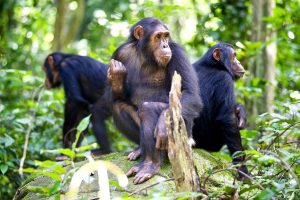
Eastern Chimpanzee Habitat and Distribution
The natural range of Eastern chimpanzees is extensive but fragmented. They occur from parts of the Central African Republic and Democratic Republic of Congo across to Uganda, Rwanda, Burundi and western Tanzania, with small or relict populations in South Sudan.
The forests of the Albertine Rift are particularly important for the subspecies. This region contains some of Africa’s most biologically diverse ecosystems and provides habitat for chimpanzees alongside gorillas, monkeys, forest elephants, birds and numerous other species.
In Uganda, Eastern chimpanzees can be found in several important forests. Kibale National Park is particularly famous for its high concentration of primates, while Budongo Forest in the greater Murchison Falls landscape is another important chimpanzee habitat.
The distribution of chimpanzees is not continuous. Human settlement, agriculture, roads, logging and other forms of habitat change have fragmented many forests. This makes conservation corridors and protected forests extremely important for maintaining chimpanzee populations.
Interesting Facts About Eastern Chimpanzees
Eastern chimpanzees have many characteristics that make them fascinating to observe. Their intelligence, social organization and adaptability have been studied for decades.
They are among the best-studied chimpanzees
Eastern chimpanzees are probably the most extensively studied chimpanzee subspecies. Some of the world’s longest-running studies of wild chimpanzees have taken place within their range.
The work of Jane Goodall at Gombe Stream National Park in Tanzania is particularly famous. Her long-term observations helped transform scientific understanding of chimpanzee behaviour and demonstrated how complex their social lives could be.
Researchers have also conducted extensive studies in Uganda’s Kibale Forest and Budongo Forest. These studies have contributed to knowledge about chimpanzee communication, feeding, reproduction, social relationships, territorial behaviour and conservation.
They live both in trees and on the ground
Eastern chimpanzees are both arboreal and terrestrial. They spend significant amounts of time in trees, particularly when feeding, moving through the forest and building nests for sleeping.
At night, chimpanzees normally construct nests in trees from branches and leaves. Each chimpanzee generally builds its own sleeping nest, although mothers and very young infants may share nests.
During the day, chimpanzees spend considerable time on the ground. They can walk using their knuckles and the soles of their feet and can also move through trees using their long arms and strong hands.
Chimpanzees are capable of walking upright for short distances, although their normal movement on the ground is quadrupedal.
They are highly intelligent
One of the most remarkable characteristics of Eastern chimpanzees is their intelligence. They can solve problems, remember locations, learn from other individuals and use objects as tools. Different chimpanzee communities can develop their own traditions. For example, one community may use a particular technique to obtain food while another population may use a different method. This ability to learn and pass behaviours between generations is one reason researchers describe some chimpanzee behaviours as cultural traditions.
They have complex social lives
Chimpanzees live in large communities that can contain many individuals. However, they do not necessarily move together as one large group all the time. Instead, chimpanzee communities operate using a flexible social system often referred to as fission-fusion. Individuals may divide into smaller groups called parties and later reunite with other members of their community. These groups can change depending on food availability, social relationships and other environmental conditions. Chimpanzees spend considerable time grooming, playing, feeding and interacting with one another. Grooming is particularly important because it helps maintain social relationships.
How Eastern Chimpanzees Differ From Other Chimpanzees
Eastern chimpanzees are one of four commonly recognized subspecies of the common chimpanzee. The others are the Western chimpanzee, Central chimpanzee and Nigeria-Cameroon chimpanzee.
The differences between these subspecies are often subtle because they are closely related. Geography, habitat, physical characteristics and behaviour can all help distinguish the populations. Eastern chimpanzees are sometimes described as having relatively long hair and a particular combination of body proportions compared with some other chimpanzee populations. However, individual variation exists, so it is not always possible to identify a subspecies simply by looking at one animal.
Their geographical range is one of the clearest distinctions. Eastern chimpanzees are associated with Central and East Africa, while Western chimpanzees occur primarily in West Africa and Central chimpanzees occur farther west in the Congo Basin. Eastern chimpanzees are also especially well known because of the extensive scientific research conducted within their range.
Common Chimpanzees
The term common chimpanzee refers to the species Pan troglodytes, which includes the recognized chimpanzee subspecies. They are sometimes also called robust chimpanzees.
Common chimpanzees occur across a broad belt of tropical Africa. Their range extends from West Africa through Central Africa to East Africa, although populations are separated by large areas where chimpanzees no longer occur.
Their habitats include tropical rainforests, woodland, forest edges, wetlands and some savannah-forest mosaics.
Uganda, Rwanda, Tanzania and the Democratic Republic of Congo are particularly important destinations for travelers interested in chimpanzees.
Interesting Facts About Common Chimpanzees
Common chimpanzees are famous for their ability to learn and use tools. They can use sticks to extract termites and ants, stones to crack nuts and leaves or other materials for different purposes.
Chimpanzees have also demonstrated an impressive ability to learn symbols and forms of communication in controlled research environments. Some captive chimpanzees have been taught forms of sign-based or symbolic communication, although this should not be interpreted as chimpanzees naturally speaking human sign language in the same way humans do.
They are also highly social animals. Young chimpanzees spend a great deal of time playing with one another, including chasing, wrestling and climbing.
Play is important for developing physical skills and social relationships. Young chimpanzees can also learn important behaviours by observing older members of their community.
Western Chimpanzees
Western chimpanzees are another recognized subspecies of the common chimpanzee. They are scientifically known as Pan troglodytes verus and occur primarily in West Africa.
Their range includes countries such as Côte d’Ivoire, Ghana, Guinea, Guinea-Bissau, Liberia, Mali, Senegal and Sierra Leone. Their populations have declined significantly over time because of habitat loss, hunting and other human pressures. Western chimpanzees have developed several interesting behaviours that distinguish particular communities.
Interesting Facts About Western Chimpanzees
Some Western chimpanzee communities in Senegal are known for unusual tool-use behaviours. Researchers have documented the use of wooden tools during hunting, particularly when targeting small mammals such as bush babies.
This is an impressive example of chimpanzee intelligence because the animals may select and modify branches before using them. Some Western chimpanzee communities also interact with caves and rocky shelters, particularly in the hot and relatively dry landscapes of Senegal. These shelters can provide shade and protection from the heat.
Researchers have also documented distinctive stone-throwing and stone-accumulating behaviours in some Western chimpanzee communities. The exact meaning of these behaviours continues to be investigated. Western chimpanzees can also display interesting differences in hunting behaviour between males and females. Research in Senegal has shown that females can be active hunters, challenging older assumptions that hunting is primarily a male activity.
Central Chimpanzees
Central chimpanzees, scientifically known as Pan troglodytes troglodytes, occupy parts of the Congo Basin. Their range includes countries such as Cameroon, the Republic of Congo, Gabon, Equatorial Guinea, the Central African Republic and parts of the Democratic Republic of Congo. The Congo Basin provides some of the most extensive tropical forest habitat for chimpanzees in Africa.
Interesting Facts About Central Chimpanzees
Central chimpanzees are highly intelligent and use tools to obtain food. They may use twigs to access termites and ants, while other tools can be used to process foods. Their social organization is also complex. Like other chimpanzees, they live in communities that can contain many individuals, although these communities regularly divide into smaller parties.
Chimpanzee societies are not simply organized around one permanent group moving together throughout the day. Instead, their flexible social system allows individuals to spend time with different members of their community. Central chimpanzees are also physically strong animals with long arms and fingers adapted to climbing and moving through their forest environment.
The differences between Central chimpanzees and the other subspecies are not always obvious to tourists. Their geographical distribution and genetic characteristics are more reliable ways of distinguishing them than simple visual observations.
Trekking the Different Chimpanzee Species
Chimpanzee trekking is one of the most exciting primate activities in Africa. It gives visitors an opportunity to enter forests and observe chimpanzees in their natural environment. Chimpanzee trekking is available in several countries, including Uganda, Rwanda and Tanzania, although the exact experience, rules, fees and amount of time spent with the animals vary from one destination to another.
In Uganda, important chimpanzee trekking destinations include Kibale National Park, Kyambura Gorge in Queen Elizabeth National Park and selected forest reserves such as Kalinzu. Rwanda offers chimpanzee experiences in Nyungwe National Park, while Tanzania is famous for Gombe Stream and Mahale Mountains national parks.
A typical trekking experience begins with a briefing. Visitors are informed about the rules and safety procedures, including how to behave around chimpanzees, how to minimize disturbance and how to protect the animals from human diseases. Visitors are usually divided into manageable groups, although the exact group size depends on the destination and current regulations.
The trek then begins with the assistance of trained guides and trackers. The time required to locate the chimpanzees varies considerably. Sometimes the animals are found relatively close to the starting point, while on other occasions visitors may have to walk for several hours.
The terrain can also vary. Some forests have relatively gentle trails, while others contain steep slopes, streams, thick vegetation and muddy paths. Once a chimpanzee community is located, visitors can observe the animals as they go about their daily activities. They may see chimpanzees feeding, climbing trees, grooming, playing, calling to one another, resting or moving through the forest.
The amount of time allowed with chimpanzees depends on the destination and the type of experience. The one-hour rule is common for standard chimpanzee tracking experiences, but it should not be treated as a universal rule for every destination. Uganda, for example, also offers a chimpanzee habituation experience in Kibale that allows visitors to spend considerably longer observing chimpanzees under specific regulations.
Visitors should maintain the distance required by the relevant park authority, keep their voices low and avoid sudden movements. Anyone who is sick should follow the park’s health regulations because chimpanzees are vulnerable to human diseases. Photography is normally allowed, but visitors should avoid using flash when it is prohibited and should always follow the instructions of their guide.
After the experience, travelers trek back to the park headquarters or continue with other activities depending on their itinerary. A forest trek may also provide opportunities to see other primates, birds, butterflies and, in some destinations, larger mammals.
Cost of Trekking the Different Chimpanzee Species
Chimpanzee trekking prices vary significantly between countries and individual destinations. Permit fees can also change as wildlife authorities update their tariff structures.
In Uganda, Kibale National Park’s official chimpanzee tracking tariff has historically been around US$300 for foreign non-residents, while other categories and destinations have different rates. Uganda also offers chimpanzee habituation experiences at a higher fee. Current prices should always be confirmed before booking.
Kyambura Gorge in Queen Elizabeth National Park has historically had a lower chimpanzee tracking fee than Kibale, making it an option for travelers looking for a more affordable chimpanzee experience.
Rwanda’s chimpanzee trekking is conducted in Nyungwe National Park, while Tanzania offers chimpanzee experiences in Gombe Stream and Mahale Mountains national parks. Their fees are different from Uganda’s and may also change over time. Rather than relying on an old fixed price, travelers should confirm the current permit fee with the relevant wildlife authority or their tour operator before making a booking.
The overall cost of a chimpanzee safari also includes other expenses such as transportation, accommodation, meals, park entrance fees and guide services. For this reason, a traveler comparing destinations should consider the complete safari package rather than looking only at the chimpanzee permit.
Best Time to Go Trekking the Chimpanzees
Chimpanzee trekking is possible throughout much of the year, but weather conditions can influence the experience.
The relatively drier months are often preferred by travelers because trails are generally easier to navigate and the chances of heavy rainfall interrupting the activity can be lower. In Uganda, the periods around June to September and December to February are commonly favored for many wildlife and primate activities. However, chimpanzee forests receive rainfall throughout the year, and conditions can vary between destinations. During the rainy seasons, forest trails may become muddy and slippery. However, the wet season has advantages as well.
Fruit and other food resources can become abundant, which may influence chimpanzee movements. The forests also become particularly green and beautiful, providing excellent photographic scenery. In some destinations, chimpanzees may remain closer to certain areas when food is readily available, although their movements can never be predicted with certainty.
For birdwatchers and nature enthusiasts, the rainy seasons can also be rewarding because forests become highly active with vegetation, insects and birds. Travelers should therefore choose the season according to their priorities. Those who prioritize easier hiking conditions may prefer the drier months, while visitors who enjoy lush scenery and are comfortable with occasional rain may also enjoy the wet season.
Conservation of Eastern Chimpanzees
Eastern chimpanzees are classified as Endangered, and their populations face serious conservation challenges. Habitat loss is one of the major threats. Agricultural expansion, logging, infrastructure development and human settlement have fragmented forests across parts of their range. Hunting and illegal capture also pose risks. Young chimpanzees can become victims of the illegal wildlife trade after adult animals are killed.
Disease is another concern because chimpanzees are susceptible to several human pathogens. This is one reason health regulations are important during chimpanzee tourism activities. Conservation organizations, governments, researchers and local communities are working to protect chimpanzee populations through protected areas, habitat restoration, research, law enforcement and community conservation programs. Tourism can also contribute to conservation. Permit fees, park revenues, guiding services, accommodation and other tourism activities can generate income that supports protected areas and local communities.
Why Chimpanzee Trekking Is Worth Experiencing
Chimpanzee trekking provides travelers with much more than a simple wildlife sighting. It offers an opportunity to observe one of humanity’s closest living relatives in its natural environment. Watching a chimpanzee groom another individual, carry a young infant, feed on fruit, communicate with other members of its community or move effortlessly through the trees can provide a deeper understanding of these remarkable animals.
The experience also introduces visitors to the forests themselves. The sound of birds, movement of monkeys through the canopy, giant trees, butterflies and changing forest vegetation all contribute to the adventure. Uganda, Rwanda and Tanzania each provide different chimpanzee experiences, while the Democratic Republic of Congo and other countries contain important wild populations and conservation landscapes.
Conclusion
Eastern chimpanzees are among Africa’s most fascinating great apes. Their intelligence, complex social relationships, tool use and remarkable similarities to humans have made them the subject of decades of scientific research.
They occupy a wide range across Central and East Africa, with important populations in Uganda, Rwanda, Tanzania, Burundi and the Democratic Republic of Congo. Uganda is particularly important for chimpanzee tourism, with destinations such as Kibale National Park, Budongo Forest and Kyambura Gorge providing opportunities to observe these animals in their natural habitat.
The different chimpanzee subspecies also demonstrate how wildlife can adapt to different environments. Western chimpanzees have developed distinctive behaviours in the dry landscapes of West Africa, Central chimpanzees inhabit the vast forests of the Congo Basin, while Eastern chimpanzees thrive in forests and woodland ecosystems stretching across Central and East Africa.
Chimpanzee trekking offers an opportunity to witness these animals at close range while also exploring some of Africa’s most beautiful forests. With responsible tourism, strong conservation programs and continued protection of their habitats, these remarkable primates can continue to survive for generations to come.