Western Lowland Gorillas: Facts, Habitat, Behaviour and Conservation
Western Lowland Gorillas are one of the four recognized subspecies of gorillas in Africa and are the smallest of the four gorilla subspecies. Scientifically known as Gorilla gorilla gorilla, they are a subspecies of the Western Gorilla and are primarily found in the dense tropical rainforests of Central Africa. Their natural range extends across countries including Cameroon, the Central African Republic, Equatorial Guinea, Gabon and the Republic of Congo, with some historical or possible remnant populations in the Democratic Republic of Congo. Unlike mountain gorillas, which are restricted to high-altitude forests in Uganda, Rwanda and the Democratic Republic of Congo, Western Lowland Gorillas mainly inhabit lowland tropical forests, swamp forests and forest clearings.
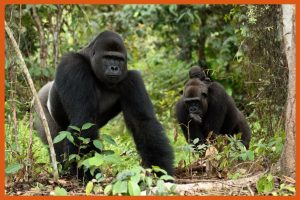
Western Lowland Gorillas are classified as Critically Endangered, largely because of the severe decline they have experienced from disease, poaching and habitat disturbance. Although they remain the most numerous and widely distributed of the gorilla subspecies, scientists do not have a precise current population count because many of them live in remote and difficult-to-survey forests of the Congo Basin. Conservation organizations estimate that their numbers have declined dramatically over recent decades, with some populations suffering particularly severe losses from Ebola outbreaks.
The Western Lowland Gorilla is sometimes simply referred to as the Western Gorilla. The four recognized gorilla subspecies are the Western Lowland Gorilla, Cross River Gorilla, Mountain Gorilla and Eastern Lowland Gorilla, also known as Grauer’s Gorilla. The Western Lowland Gorilla is distinguished by its somewhat smaller body size, brownish or greyish-black coat and broader skull compared with some of the other subspecies.
Where Do Western Lowland Gorillas Live?
Western Lowland Gorillas inhabit some of Africa’s most extensive tropical forests. Much of their range lies within the Congo Basin, one of the most important rainforest regions in the world. These forests provide food, shelter and space for gorillas while also supporting thousands of other species of plants and animals.
Important populations occur in the forests of the Republic of Congo, Gabon, Cameroon, the Central African Republic and Equatorial Guinea. The Republic of Congo contains particularly important populations in remote forest landscapes, while the Dzanga-Sangha protected areas in the Central African Republic are also known for their Western Lowland Gorilla conservation and tourism programs.
The forests where these gorillas live are not uniform. They include dense tropical rainforest, swamp forests, marshy areas and natural clearings known locally as bais. These clearings can become important places for wildlife because they provide access to minerals, water, vegetation and other food resources.
Western Lowland Gorillas are also important to the health of their forest ecosystem. As they move through the forest and feed on fruits and vegetation, they help disperse seeds over considerable distances. Their feeding activities can influence forest regeneration and contribute to the maintenance of plant diversity.
Appearance of Western Lowland Gorillas
Western Lowland Gorillas have a powerful and muscular appearance, although they are smaller than the other gorilla subspecies. Their bodies are covered in short hair that can range from black to brownish-grey. Older males develop the characteristic silver or grey hair across their backs, which gives them the name “silverback.”
Their hands are large and strong, with fingers and nails that resemble those of humans. Gorillas also have opposable thumbs, allowing them to grasp branches, vegetation and objects. Like humans, individual gorillas have distinctive fingerprints, while they also possess unique nose prints that can help researchers identify individuals.
Adult males are substantially larger than females. A mature male can weigh around 136 kilograms on average and may reach considerably more than this, while large males can stand close to 1.8 metres tall when upright. Females are smaller, generally weighing around 70 to 90 kilograms, although individual sizes vary. Adult males can also have an arm span of around 2.4 metres, demonstrating how their long arms are adapted to movement through the forest.
Their arms are longer than their legs, which is an important adaptation for moving through their forest environment. Although gorillas can stand and walk upright for short periods, they normally move on all four limbs using a method known as knuckle-walking. They support much of their weight on the curled fingers of their hands while moving across the forest floor.
Social Life and Family Groups
Western Lowland Gorillas are highly social animals. They normally live in groups, often called troops or family groups, although the size and structure of groups can vary considerably. A group commonly contains a dominant silverback, several adult females, younger males and infants. Some groups may contain only a few individuals, while others can become much larger.
The silverback plays an important role in maintaining the stability of the group. He protects the group from potential threats, leads movements between feeding areas and sleeping sites, and plays an important role in reproduction. He may also intervene in conflicts between group members and protect females and young gorillas when danger occurs.
The social structure of gorillas is more complex than simply having one male controlling every activity. Individual gorillas develop strong relationships through grooming, feeding together, playing and other social interactions. Young gorillas spend considerable time close to their mothers and gradually learn how to behave within the group.
In some situations, young males may eventually leave their birth group. They can travel alone for a period or form bachelor groups with other males before establishing or joining a breeding group of their own.
Movement and Daily Activities
Western Lowland Gorillas have relatively large home ranges because they must continually search for enough food. Depending on habitat conditions and food availability, their home range can cover many square kilometres. Their daily movements also change according to the season, availability of fruit and vegetation, and the location of preferred feeding areas.
They spend a large part of the day feeding. Their diet is primarily vegetarian and includes fruits, leaves, stems, herbs, bark and other plant materials. They may also eat insects such as termites, particularly when these provide an easily accessible source of protein.
Fruit can be particularly important when it is abundant. When fruiting trees are available, gorillas may travel significant distances to reach them. During periods when fruit is less available, they rely more heavily on leaves, stems, bark and other vegetation.
Western Lowland Gorillas may travel several kilometres during a day while searching for food. Their movements also contribute to the dispersal of seeds throughout the forest. This makes them important ecological agents because the seeds they consume can later germinate in different parts of the forest.
Gorilla Nests and Sleeping Habits
Like other wild gorillas, Western Lowland Gorillas normally build nests for sleeping. Nests may be constructed on the ground or in trees, depending on the individual gorilla, habitat and circumstances.
The gorillas use vegetation such as leaves, branches and other plant material to create a relatively comfortable sleeping platform. Mothers may sleep close to their young, while other members of the group construct their own nests nearby.
Researchers can sometimes use gorilla nests to study the presence and movement of groups in areas where direct observation is difficult. The number, location and age of nests can provide useful information about gorilla distribution and habitat use.
Reproduction and Young Gorillas
Western Lowland Gorillas reproduce slowly compared with many other mammals. This slow reproductive rate is one of the reasons why their populations can take many years to recover after suffering from disease, hunting or other disturbances.
Female gorillas reach sexual maturity at around seven or eight years, although they may begin reproducing later. Once a female begins breeding, she normally gives birth to one infant at a time, with births separated by several years. Gorilla gestation lasts approximately eight and a half months.
Newborn gorillas are small compared with adults and depend heavily on their mothers. The mother carries the infant and keeps it close to her body during its earliest months. As the young gorilla grows stronger, it gradually becomes more independent and begins to explore its surroundings.
Infants spend several years learning important skills from their mothers and other members of the group. They learn what foods are safe to eat, how to move through the forest, how to interact socially and how to respond to potential threats.
The strong relationship between a mother and her infant is therefore important not only for survival but also for the development of social and behavioural skills.
Intelligence and Use of Tools
Western Lowland Gorillas are intelligent animals capable of learning, problem-solving and using objects in their environment. Although they do not use tools in exactly the same way humans do, researchers have documented gorillas using natural objects for practical purposes.
For example, gorillas may use sticks to test water depth, help themselves move through difficult terrain or manipulate food. In some forest environments, females have been observed using sticks when approaching or crossing water, particularly when accompanied by young gorillas. Their intelligence can also be seen through their ability to remember locations, recognize individuals and adapt their behaviour to changing circumstances. Gorillas have complex social relationships and communicate using vocalizations, gestures, facial expressions and body movements. These abilities have made gorillas important subjects in research into primate behaviour and cognition.
Communication Among Western Lowland Gorillas
Communication is an important part of gorilla social life. Gorillas use different sounds, gestures and body postures to express emotions and intentions. Some vocalizations are associated with alarm, aggression, contact between group members or maintaining cohesion.
Silverbacks may use displays to warn other gorillas or potential competitors. These displays can include standing upright, beating the chest, making vocalizations and moving aggressively. However, chest beating is not simply an act of aggression; it can serve as a form of communication and may help individuals assess one another without immediately engaging in physical conflict. Gorilla communication is particularly important in dense forests where members of a group may temporarily move out of one another’s direct line of sight.
Western Lowland Gorillas and Human Diseases
Because gorillas are closely related to humans, they can be susceptible to some diseases that affect people. This is an important conservation concern, particularly in areas where gorillas come into close contact with humans.
Western Lowland Gorillas have suffered devastating losses from Ebola outbreaks. In some areas of Central Africa, Ebola has killed very large numbers of gorillas and chimpanzees. Researchers have estimated that Ebola contributed to the death of a substantial proportion of wild gorillas in affected regions.
It is important, however, to correct a common misconception about HIV/AIDS. There is no reliable scientific basis for saying that HIV/AIDS “came from Western Lowland Gorillas.” HIV-1 is understood to have originated from simian immunodeficiency viruses in African primates, particularly viruses associated with chimpanzees, rather than being established as originating from Western Lowland Gorillas.
The close genetic relationship between humans and gorillas does mean that disease transmission in either direction is a serious conservation concern. This is one reason responsible wildlife tourism requires visitors to follow health and hygiene rules when observing great apes.
Major Threats to Western Lowland Gorillas
Western Lowland Gorillas face several serious threats. The most important include habitat loss and fragmentation, poaching, disease and the wider pressures associated with human activity.
Habitat Loss
The Congo Basin forests are increasingly affected by logging, mining, road construction, agriculture and other forms of development. When forests are fragmented, gorillas can lose access to important feeding and nesting areas.
Road construction can create additional problems because previously remote forests become easier for hunters to access. Habitat fragmentation can also change the way animals move across the landscape and may increase encounters between wildlife and people.
Poaching
Poaching remains a serious threat. Gorillas may be hunted for bushmeat, while young gorillas may also be captured illegally for the wildlife trade. Gorillas can also be accidentally injured or killed by snares intended for other forest animals. The combination of hunting and slow reproduction is particularly damaging. Because females produce offspring only after relatively long intervals, populations cannot quickly replace animals lost through hunting or disease.
Disease
Disease remains one of the most significant threats to Western Lowland Gorillas. Ebola outbreaks have caused severe population declines in parts of their range. Other diseases can also move between humans and great apes, making health monitoring and responsible human-wildlife interaction extremely important.
Conservation of Western Lowland Gorillas
Conservation organizations, governments, researchers and local communities are working together to protect Western Lowland Gorillas and their forest habitats. The conservation approaches include anti-poaching patrols, habitat protection, scientific research, disease monitoring and community-based conservation.
Protected areas provide important refuges for gorillas, although a significant proportion of Western Lowland Gorillas live outside formally protected areas. WWF notes that only a minority of Western Lowland Gorillas occur within protected areas, highlighting the importance of protecting wider forest landscapes and working with communities that depend on these forests.
One important example is the Dzanga-Sangha protected landscape in the Central African Republic, where conservation programs combine wildlife protection, research and tourism. Indigenous BaAka communities are also involved in conservation and gorilla habituation activities in the area.
Gorilla tourism, when carefully managed, can provide an economic reason to conserve forests. Visitors who travel to destinations where Western Lowland Gorillas can be observed contribute to local employment, guiding services, accommodation, transport and conservation programs. This creates an opportunity for tourism to support both wildlife protection and local livelihoods.
Can You See Western Lowland Gorillas in the Wild?
Yes, Western Lowland Gorillas can be observed in certain protected areas of Central Africa, although opportunities are more limited than mountain gorilla trekking in Uganda and Rwanda. The Republic of Congo and the Central African Republic are among the destinations associated with Western Lowland Gorilla tourism and habituation experiences. In Dzanga-Sangha, for example, visitors can participate in carefully managed experiences involving gorilla groups that have become accustomed to limited human presence.
Seeing Western Lowland Gorillas in their natural environment can be a remarkable experience, particularly because these animals inhabit remote rainforest landscapes. Unlike the more established mountain gorilla tourism industry around Bwindi and the Virunga Mountains, Western Lowland Gorilla tourism remains relatively specialized.
Visitors should always follow the rules established by park authorities and conservation organizations. Maintaining a safe distance, following guide instructions, avoiding sudden movements and observing health requirements are important ways of reducing stress and disease risks to gorillas.
Why Western Lowland Gorillas Matter
Western Lowland Gorillas are important not only because they are one of Africa’s remarkable great apes but also because they play an important ecological role in tropical forests. Their feeding and movement patterns help distribute seeds, influence vegetation and contribute to the natural functioning of rainforest ecosystems.
They are also an important symbol of the Congo Basin’s remaining wilderness. Protecting their habitat means protecting many other species that share the same forests, including forest elephants, chimpanzees, monkeys, birds, reptiles and countless plant species. Their conservation is therefore much larger than saving a single animal. Protecting Western Lowland Gorillas also means protecting forests, supporting local communities, reducing illegal hunting and maintaining one of the world’s most important tropical ecosystems.
Western Lowland Gorillas remain Critically Endangered, and their future depends on continued conservation efforts. Their slow reproductive rate means that populations cannot recover quickly after major losses, making prevention of poaching, disease outbreaks and habitat destruction particularly important.
For travelers interested in great apes, Central Africa offers an opportunity to learn about these fascinating animals in a very different environment from the mountain gorilla habitats of Uganda and Rwanda. Responsible gorilla tourism can help create awareness, support conservation initiatives and provide benefits to communities living around protected forests.
For more information about Western Lowland Gorillas, gorilla tourism in Central Africa, conservation experiences and planning a wildlife adventure, feel free to contact us.